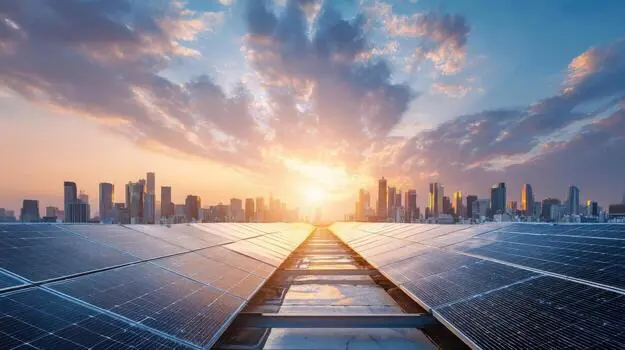
Rooftop solar has stopped being an eco-statement and become an escape hatch. Across every continent, households and factories are quietly rewiring the world’s energy system from the roof down — and the numbers now make the case better than any ideology could.
On a factory roof in Karachi, 2,900 panels tilt south in disciplined rows; the owner no longer talks about climate, he talks about the 41 per cent his energy bill fell. On a dairy farm in Bavaria, the barn roof out-earns the herd. In the Australian suburbs, one in three homes now generates its own power. Multiply those roofs by tens of millions, and you have the quietest infrastructure revolution of the century so far.
The maths that changed everything
Over the past decade the global price of a solar panel has fallen roughly 80 per cent, while grid electricity tariffs almost everywhere have climbed. Somewhere around 2021, in dozens of countries at once, the two lines crossed: a typical household system began paying for itself in three to five years, against a panel life of twenty-five. Add net metering — selling surplus back to the grid — and the rooftop stops being an expense and becomes a small, humming asset.
“Nobody bought solar to save the planet. They bought it to stop the generator.”— A solar installer in Lahore
The rooftop middle class
The first wave was wealthy: whole-roof arrays on hillside villas. The second wave is more interesting. It is the 6-kilowatt system split across three cousins in a Lahore suburb; the fabric trader in Faisalabad running shop fans off five panels; the village in Bangladesh where clusters of households share one technician, found through a WhatsApp group that trades advice like a stock market. Bangladesh’s solar home programme alone has connected tens of millions of people who never had a wire at all.
What grids are learning
The utilities are learning, uncomfortably. Every rooftop that defects takes a paying customer with it, leaving fixed costs spread over those who remain — engineers call it the “death spiral” the way sailors talk about weather: quietly, and only among themselves. Meanwhile, the upside is real: every kilowatt generated at noon is a kilowatt the strained national grid does not have to find at its worst hour.
The catch
Two clouds sit over the boom. Storage remains expensive; without batteries, the rooftop goes dark exactly when the grid does, which is to say at night. And in a decade or so, the first great wave of panels will start retiring — a slow-motion e-waste question nobody has fully answered yet.
But the direction is settled, in the way directions settle before policies do. The world is becoming a planet that powers itself from its own roofs — quietly, in the afternoon, while everyone is at work. The same quiet shift is remaking who works, and where; the roof and the laptop have more in common than they look.