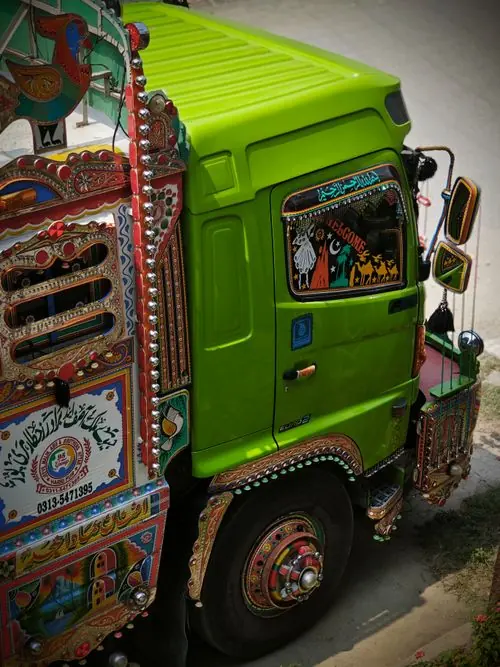
On a highway anywhere in the world, a truck may pass you that is really a gallery: peacocks on its flanks, chrome crowns catching the sun, calligraphy above the windscreen, and on the back panel, painted with total confidence, an invitation to “look — but with love.” Almost every culture that moves goods by road has, at some point, decided the truck deserved to be beautiful.
Here is the world tour.
Pakistan: the classic
Pakistani truck art is the tradition against which all others are measured — dense, glittering, competitive, and produced by family workshops whose painters train as ustad and shagird, master and apprentice. Nothing is stencilled: a painter freehands a door-sized panel in an afternoon, peacock by peacock. A full decoration is a serious investment — six to eight weeks of work, lacquer, hand-beaten reflective panels — and owners talk about it the way collectors talk about framing. Motifs form a grammar: peacocks for beauty, lions for strength, and above the cab, always, a blessing.
Japan: dekotora
Japan’s dekotora — decoration trucks — took the same instinct toward neon and chrome. Born from a 1970s film series about a trucker and his magnificent machine, the subculture builds rolling chandeliers of stainless steel and coloured light, part art object, part rolling shrine to the long haul.
Mexico and Peru: the camiones of the Andes
Latin America’s buses and cargo trucks carry their own renaissance: hand-painted script, airbrushed saints and slogans, family names in gold leaf. In Peru and Bolivia, the tradition fuses with Andean textile colour — vehicles as moving quilts, blessed at festivals and named like daughters.
The Philippines: the jeepney
Manila’s jeepneys — stretched leftovers of an American war, rebuilt and painted beyond recognition — are perhaps the world’s most beloved public transport: chrome horses, murals, disco roofs. They carry the same message as every truck on this list: the driver is not merely a driver; the vehicle is not merely a vehicle.
“Every painted truck is a thesis — on love, faith, distance and colour — defended at sixty kilometres an hour.”
From highway to gallery wall
In recent years the world’s museums and designers have borrowed the vocabulary — panels in biennales, motifs on benches and handbags. The painters have mixed feelings: pride, mostly, and a wry note that a canvas that hangs still is easier to paint than one that must survive the monsoon. They have a point. The gallery version glows under track lighting. The real thing still does what it was made for: it rolls, it rattles, it climbs the pass with its peacocks intact — and it passes you at sixty, looking, but with love.
If this gave you itchy feet, our guide to playing tourist at home and this year’s heritage restoration awards are the next stops.